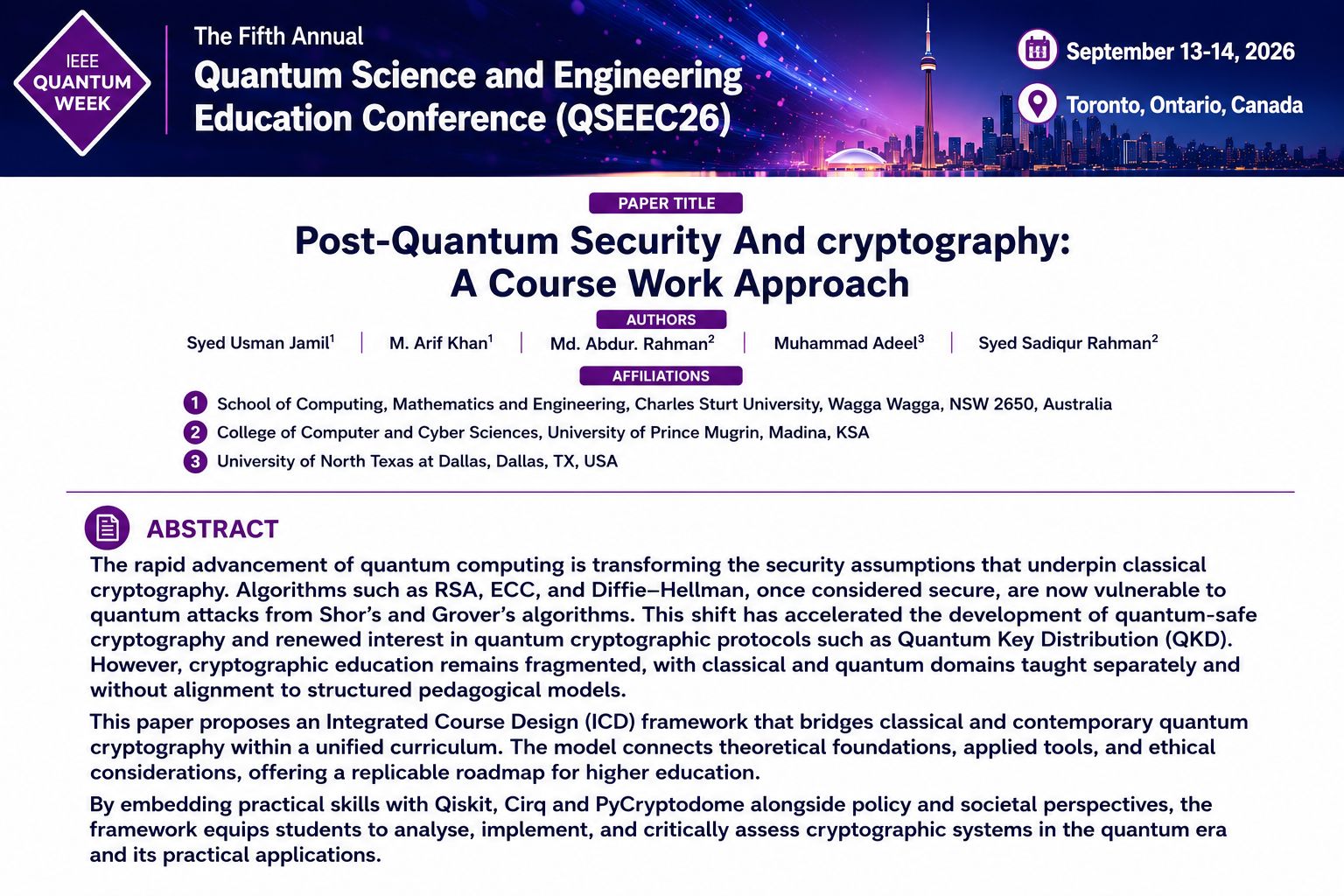
Paper Title
Post-Quantum Security And Cryptography: A Course Work Approach
Authors
Syed Usman Jamil1, M. Arif Khan1, Md. Abdur. Rahman2, Muhammad Adeel3, Syed Sadiqur Rahman2
- School of Computing, Mathematics and Engineering, Charles Sturt University, Wagga Wagga, NSW, Australia
- College of Computer and Cyber Sciences, University of Prince Mugrin, Madina, KSA
- University of North Texas at Dallas, Dallas, TX, USA
Abstract
The rapid advancement of quantum computing is transforming the security assumptions that underpin classical cryptography. Algorithms such as RSA, ECC, and Diffie–Hellman, once considered secure, are now vulnerable to quantum attacks from Shor's and Grover's algorithms. This shift has accelerated the development of quantum-safe cryptography and renewed interest in quantum cryptographic protocols such as Quantum Key Distribution (QKD). However, cryptographic education remains fragmented, with classical and quantum domains taught separately and without alignment to structured pedagogical models.
This paper proposes an Integrated Course Design (ICD) framework that bridges classical and contemporary quantum cryptography within a unified curriculum. The model connects theoretical foundations, applied tools, and ethical considerations, offering a replicable roadmap for higher education.
By embedding practical skills with Qiskit, Cirq and PyCryptodome alongside policy and societal perspectives, the framework equips students to analyse, implement, and critically assess cryptographic systems in the quantum era and its practical applications.
About the Conference
The IEEE Quantum Science and Engineering Education Conference (QSEEC) is a premier forum within IEEE Quantum Week, bringing together researchers, educators, and industry leaders to advance quantum computing education and training globally. The 2026 edition takes place in Toronto, Ontario, Canada on September 13–14, 2026.
Back to News